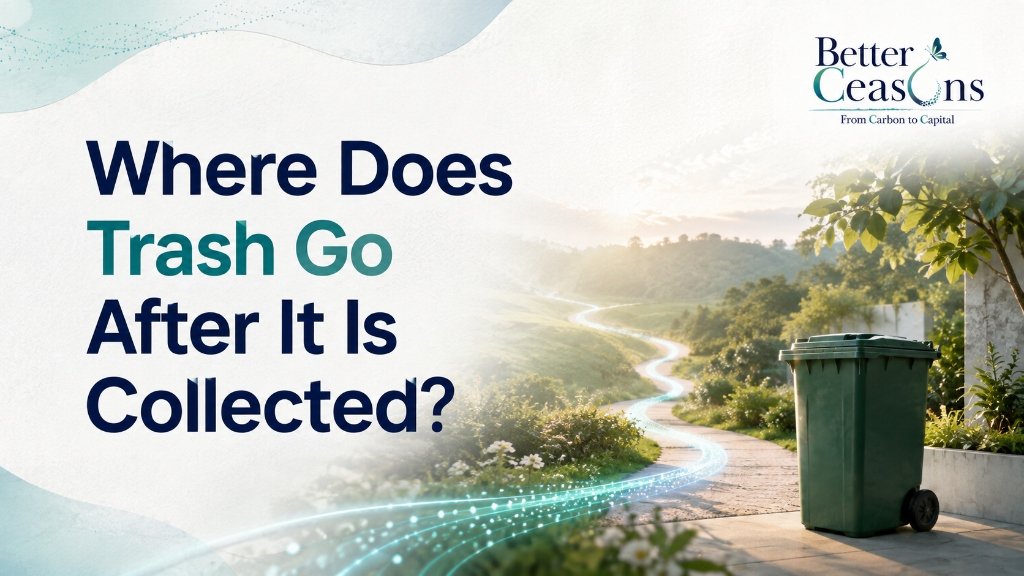
After collection, trash may travel to a transfer station, sorting facility, biological treatment plant, energy recovery unit, conversion facility or controlled disposal site depending on its composition and local infrastructure.
The collection vehicle arrives, the bin is emptied, and the waste disappears from the street. For most of us, that feels like the end of the story. The surroundings look cleaner, the smell is gone, and daily life continues. But nothing has truly disappeared. Everything placed in that bin continues its journey somewhere else. It may travel to a transfer station, pass through a sorting facility, enter a treatment plant or remain at a disposal site for many years. So, where does trash go after it is collected? The answer depends on what the waste contains, how it was collected and what processing infrastructure is available nearby. Some materials may be separated. Organic matter may enter a biological treatment system. Suitable carbon-rich materials may be considered for energy recovery or conversion. Material that cannot be processed may eventually be sent for controlled disposal. Understanding this hidden journey is important because collection only moves the problem. What happens after collection determines whether the material creates long-term environmental pressure or becomes part of a more responsible recovery system.
Collection Is Only the Beginning
Waste is collected from homes, offices, restaurants, markets, institutions and public spaces. In smaller towns, a collection vehicle may travel directly to a processing or disposal facility. In larger cities, it commonly reaches a transfer station first. A transfer station is a temporary point where material from several smaller collection vehicles is gathered. It may be compacted and loaded into larger vehicles for transportation over a longer distance. This step can reduce transportation costs, but it does not necessarily change the waste itself. Food residue, plastic packaging, paper, fabric, glass, metal and other materials may still be mixed together. Their condition often becomes more difficult to manage because liquids, moisture and dirt can spread across the entire load. The destination after the transfer station becomes the most important part of the journey.What Happens at a Sorting Facility?
At a sorting facility, workers and machines attempt to divide mixed waste into different material groups. The process may involve conveyor belts, rotating screens, magnets, air-based systems, optical scanners and manual inspection. Large objects are usually removed first. Magnets may pull out certain metals. Screens separate materials by size, while air systems divide lighter materials from heavier ones. It sounds like an organised process, but real-world waste is rarely easy to sort. A food container may still contain liquid. A packet may combine plastic film, foil, ink and adhesive. Paper may be wet or covered with food residue. Small pieces of glass can become mixed with organic matter. Even advanced equipment can struggle when materials are dirty, damaged or tightly combined. This is one reason waste separation at the point of disposal can improve material quality. However, placing materials in different bins does not guarantee that each stream will reach the right facility. Every category still needs suitable transportation, processing capacity and a practical destination.Why Is Mixed Waste So Difficult to Handle?
Mixed waste does not have a fixed composition. One collection vehicle may carry mostly food residue and packaging. Another may contain cloth, broken household products, garden matter and dry plastic-rich material. This variation matters because every treatment process has specific requirements. A biological system designed for organic matter cannot operate effectively if its input contains large quantities of glass, metal or plastic. A thermal system may also perform poorly if the material has excessive moisture. Processing facilities need to understand several characteristics before choosing a treatment method:- Moisture content
- Material composition
- Particle size
- Energy value
- Level of contamination
- Volume and consistency
- Presence of unsuitable substances
Where Does Organic Waste Go?
Organic waste includes food residue, fruit and vegetable matter, garden material and certain agricultural residues. When collected in a suitable condition, it may enter a biological treatment process. One such process uses microorganisms to break down organic matter in an environment with little or no oxygen. This can produce biogas, which may be used for heating, electricity generation or further fuel preparation. This approach is commonly discussed as organic waste to energy. The process does not work effectively with every type of organic material. Moisture, contamination, acidity and consistency can affect the result. A treatment plant also needs a reliable quantity of suitable input. If the material changes significantly from one day to another, gas production and plant performance may become unstable. Organic matter creates additional challenges when it is mixed with dry material. It decomposes quickly, releases moisture and can contaminate other items during collection and transportation. Therefore, managing organic material responsibly requires more than placing it in a separate container. It requires a complete collection and treatment system designed around its properties.What Is Waste-to-Energy Technology?
Waste to energy technology refers to processes that convert suitable waste materials into usable forms of energy. Depending on the method and input, the recovered output may include heat, electricity, gas or fuel components. Different technologies may be used for different material streams. Biological systems can process suitable organic matter, while controlled thermal systems may be used for certain dry and carbon-rich inputs. The purpose of energy recovery from waste is to capture useful value before material reaches final disposal. However, the term does not describe one universal machine or process. A plant designed for agricultural residue may not be suitable for mixed household waste. A process developed for food-rich material may fail if the input contains large amounts of plastic, glass or metal. Technology must therefore be selected according to the material, rather than forcing every material into the same system. This requires testing, engineering and careful operational control.Can Waste Be Converted Into a Resource?
Waste is often viewed as something that has lost all value. In reality, many discarded materials still contain energy, carbon or useful compounds. The challenge is identifying whether that value can be recovered safely, responsibly and practically. Resource recovery from waste focuses on finding useful outputs before material is sent for final disposal. Depending on the material and process, these outputs may include:- Heat
- Electricity
- Gas
- Fuel components
- Carbon-rich material
- Industrial feedstock
- Materials suitable for further processing
- What material is entering the system?
- How reliably can the process handle it?
- Is there a responsible and practical use for the output?
What Happens to Waste That Cannot Be Processed?
Not every collected material enters a recovery or conversion system. Some waste may be too contaminated, too wet, too inconsistent or unsuitable for the facilities available in the region. This material may eventually reach a controlled disposal site. Once deposited, it does not become inactive. Organic matter continues to break down. Rainwater may pass through layers of discarded material. Lightweight items may be carried by wind, while poorly controlled fires can release smoke. A disposal site can remain environmentally active for years. This means the question “Where does trash go?” should not end when we identify the physical location. We also need to ask:- How is the site monitored?
- How are gases managed?
- What happens to contaminated liquid?
- Can useful material still be recovered?
- How are nearby communities protected?
Why Technology Alone Cannot Solve the Problem
Advanced equipment can improve sorting, treatment and energy recovery, but technology cannot correct every weakness in a waste management system. A plant needs suitable and consistent input. It also requires trained operators, maintenance, quality control, environmental monitoring and a reliable destination for the recovered outputs. A city may install modern processing equipment, but the facility can still underperform if the incoming material is too mixed or different from what the system was designed to handle. This is why Better Ceasons focuses on understanding waste before presenting conversion as the answer. The brand introduces a cleaner way of thinking about discarded material: study what it contains, understand how it behaves and identify the most responsible pathway for managing it. Readers can explore this approach through the Better Ceasons Technology page, which introduces how natural principles of heat, pressure and time can inspire modern waste transformation systems. The objective is not to claim that one process can handle everything. It is to encourage better decisions based on material science, practical infrastructure and responsible environmental thinking.A Better Future Starts With Better Questions
The future of waste management will not depend on one solution. Different locations generate different types and quantities of waste. A dense city, an agricultural region and an industrial zone cannot rely on identical systems. Future infrastructure will need a combination of better collection, material-specific processing, biological treatment, energy recovery, conversion technology and controlled disposal for material that cannot be treated responsibly. Accurate data will also be essential. Cities and organisations need to understand how much waste they generate, what it contains and how its composition changes over time. Without that information, treatment plants may be designed around assumptions rather than real material conditions.Where Better Ceasons Fits Into the Journey
Better Ceasons is built around the idea that waste management requires clearer thinking and better understanding. The platform explores the unseen journey of waste, introduces responsible ideas around material conversion and energy recovery, and helps readers understand why different waste streams require different treatment systems. Rather than presenting waste as something to be hidden, Better Ceasons encourages municipalities, industries and individuals to ask better questions about what happens after collection. Through research-backed content, practical insights and clear explanations, Better Ceasons helps bridge the gap between waste generation, resource recovery and cleaner technology.The Bin Is Not the End
The bin is only the first step in a long and complex journey. When we put trash outside, it does not vanish. It moves into a system that must sort it, process it, recover its energy or store it for the future. Understanding where trash goes after collection helps us see waste for what it really is: a material challenge that requires better decisions, suitable technology and responsible management at every stage.Key Questions Answered
What Happens at a Sorting Facility?↓
At a sorting facility, workers and machines attempt to divide mixed waste into different material groups.
Why Is Mixed Waste So Difficult to Handle?↓
Mixed waste does not have a fixed composition.
Where Does Organic Waste Go?↓
Organic waste includes food residue, fruit and vegetable matter, garden material and certain agricultural residues.
What Is Waste-to-Energy Technology?↓
Waste to energy technology refers to processes that convert suitable waste materials into usable forms of energy.
Can Waste Be Converted Into a Resource?↓
Waste is often viewed as something that has lost all value.
What Happens to Waste That Cannot Be Processed?↓
Not every collected material enters a recovery or conversion system.
Written by Team Better Seasons
Sanitation & Bioenergy Editorial Board
Better Ceasons is a clean-technology enterprise transforming municipal solid waste streams into high-value carbon resources and renewable energy.
Implement Clean Tech in Your Municipality
Better Ceasons deploys continuous, automated pyrolysis systems designed to process mixed organic waste. Connect with our engineering partners today.
Contact Our Team