01
Pidilite Industries

Madhukar Parekh
Co-Founder
 ×
×
A story of Better Ceasons and the Institute of Chemical Technology (ICT), a nine-decade-old institution and a new-wave biotech company coming together to redefine how India handles its waste, its energy, and its future.
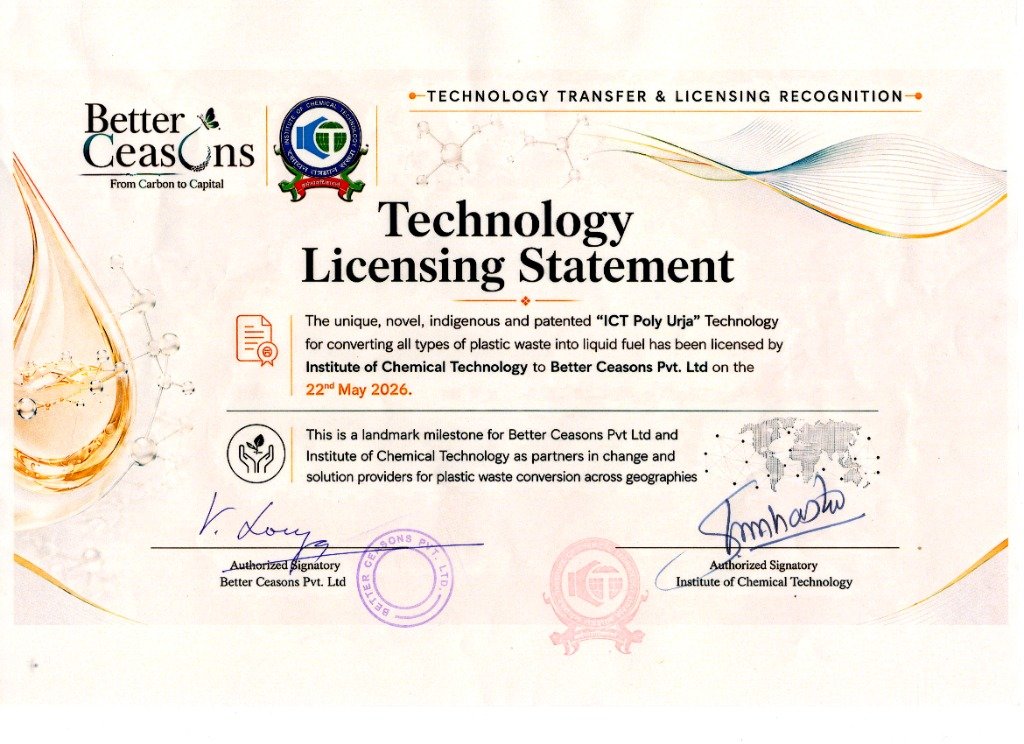
Technology Licensing Statement · 22 May 2026
8%
of India's GDP attributed to ICT alumni
The Roll Call
Institute of Chemical Technology
Madhukar Parekh
Co-Founder
Mukesh Dhirubhai Ambani
Chairman & Builder

Ashwin S. Dani
Key Leadership

Prafulla Chhajed
Leadership

Kallam Anji Reddy
Founder

Nilesh Gupta
Leadership

Ajay Piramal
Founder

Ramesh Chauhan
Chairman & Builder

Indravadan Modi
Founder

Pramod Chaudhari
Founder
The Partnership
Hence, we at Better Ceasons, decided to take our technology and partner with one of the leading Bio Technology development experts in the country.
The Institute of Chemical Technology stands as one of India's most respected institutions in chemical engineering, pharmaceuticals, and allied sciences, with roots tracing back to 1933. Over decades, it has built a reputation for rigorous academics, deep industry integration, and a research-driven culture that has directly shaped India's chemical, pharmaceutical, and manufacturing sectors.
What ICT brings to the partnership
A Deemed University whose platforms in Bio-Technology provide bridges for new wave start-ups to explore global opportunities in deep-tech.
ICT's areas of strength
Dedicated to industrial collaboration.
Premier reputation in Biotechnology, largely driven by its unique "bioprocess" approach which bridges pure biology with industrial engineering.
Widely considered one of the top institutions in India for specialised biotech research.
The impact is defined by its ability to move research from the lab to the factory floor.
ICT is accomplished in technology transfer, with developments in hydrogen production and waste-to-energy successfully scaled and integrated with companies like ONGC and BCPL respectively.
DBT-ICT Centre for Energy Biosciences is India's first centre dedicated to bio-energy and bio-fuels.
A global leader in 2G-Ethanol technology, which has been commercialised with major oil companies like HPCL.
ICT Biological Sciences & Biotechnology
The department's impact is defined by its ability to move research from the lab to the factory level — and to help industry create and execute solutions to the most intricate waste-to-energy problems.
The most recent venture is the joint development initiative with BCPL for transforming the landscape of waste management across geographies and across platforms using bio science.
The department's impact is defined by its ability to move research from the lab to the factory level and to help industry create and execute solutions to solve the most intricate waste to energy problems.
ICT's Biotechnology division stands out for its specialised focus on bio-industrial applications and commercialised technology.
ICT is now a world authority in Bioprocess Technology, Biofuels and Industrial Biotechnology.
Advancing scientific methodologies, laboratory processes, and market translation pathways for clean waste conversions.
Conducting academic waste to energy research is critical to understand the heterogeneous composition of municipal waste. Every feedstock has distinct chemical profiles that affect reactor thermal stability. Our team collaborates with universities on waste to energy research to build database baselines.
Furthermore, scientific waste to energy research helps test catalyst formulations under continuous load. In India, local feedstocks have high moisture levels, requiring customized pre-treatment steps. We share our findings to support global waste to energy research initiatives.
Achieving operational efficiency in resource recovery relies on continuous waste to energy innovation. We design modular reactor systems to support regional waste to energy innovation. Integrating these upgrades is key to handling mixed municipal residues.
In addition, our commitment to clean technology research focuses on zero process emissions. Developing new systems requires scaling clean technology research for Indian urban centers. We publish data to help transition laboratory concepts to industrial scales.
The growth of industrial biotechnology India is supported by agricultural residue processing. Through biological conversion, industrial biotechnology India creates stable biopolymers and biofuels. Deploying these platforms across regional clusters supports economic growth.
We track chemical catalyst performance to expand the scope of industrial biotechnology India. Better Ceasons develops high-yield enzyme mixes for bio-recoveries. Scaling this technology supports sustainable agricultural growth in India.
Transitioning lab to market technology involves scaling batch reactors to continuous flow systems. A successful lab to market technology path requires pilot-scale stress testing. We study thermal transfer parameters to optimize lab to market technology transfers.
At scale, a commercial scale waste to energy plant operates continuously to treat municipal residues. Setting up a commercial scale waste to energy plant requires verified feedstock agreements. Better Ceasons supports project scale-up from lab testing to commercial operations.
Click on any parameter to explore its technical specifications, chemical processes, and real-world applications.
Key queries and clarifications on municipal waste conversion systems.
Waste to energy research India — local municipal solid waste ki heterogeneous property ko assess karne ke liye Indian institutions research lab set-up kar rahe hain. Better Ceasons bhi waste to energy research India ke projects ko lead kar raha hai.
Waste to energy innovation kya hai — iska matlab hai low-emission thermochemical reactors develop karna jo organic matter ko high-grade solid carbon aur bio-oil mein efficiently convert kar sakein, jisse hum waste to energy innovation kya hai ko support karte hain.
Clean technology research kya hai — is research ke under high carbon efficiency aur zero toxic emission process pathways ko trace kiya jata hai, taaki material conversion systems environment friendly ho sakein aur clean technology research kya hai ka logic work kare.
Lab se market tak technology kaise pahuchti hai — benchtop tests ke baad pilot scaling aur stress testing ki jaati hai taaki system yields optimize ho sakein aur hum safely samajh sakein ki lab se market tak technology kaise pahuchti hai.
Commercial waste to energy plant kaise kaam karta hai — yeh plants massive industrial feeding screw conveyors aur multi-stage condensors ke sath continuous run hote hain taaki solid wastes se syngas recover ki ja sake. Yeh commercial waste to energy plant kaise kaam karta hai ke practical parameters hain.